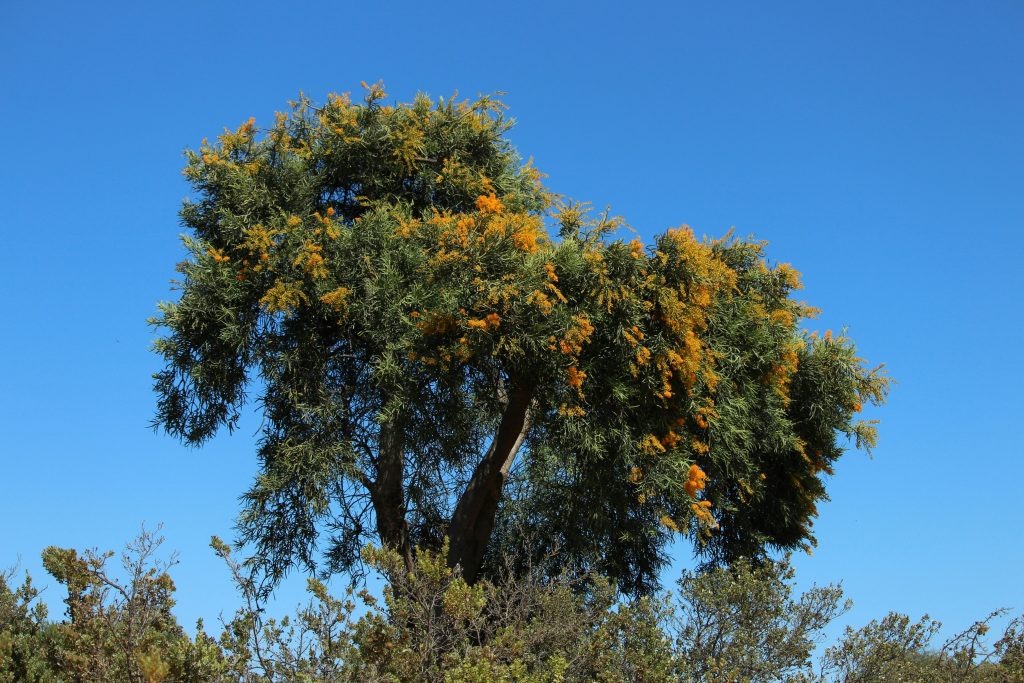
Not all native trees suit Perth’s sandy soils and dry summers. This guide covers the 10 best Treebate-eligible native trees for Perth backyards — chosen for real performance in WA conditions, with honest advice on size, soil, and what to watch out for before you buy.
New to Treebate? Read our Complete Guide to Claiming Your $150 Treebate before heading to the nursery.
What Makes a Great Perth Backyard Tree
Before diving into the list, three factors matter most when selecting a tree for a Perth suburban block.
Mature size. A tree that looks perfect in a pot may look very different ten years after planting. Always know the mature height and canopy spread before purchasing.
Soil tolerance. Most Perth soils are deep, grey, and low in nutrients. This guide focuses on species suited to those actual conditions.
PSHB risk profile. Perth has a permanent Polyphagous Shot-Hole Borer infestation across the entire metropolitan area. Before purchasing any species, check your suburb’s zone at dpird.wa.gov.au/pshb and cross-reference against the DPIRD WA Host List. Some species are blocked for Management Zone customers. Getting this wrong wastes your one rebate claim.
The Top 10
1. Silver Princess — Eucalyptus caesia
- Mature size: 5–8m tall × 4m wide
- Flowers: Large pink-red blooms, winter through spring
- Soil: Well-drained sandy or loamy soils; will not tolerate waterlogging
- Treebate eligible: ✓
- PSHB: ✅ Not listed on DPIRD Host List v6
The Silver Princess is a standout feature tree, admired for its weeping form, silver-white bark, and striking pink-red flowers during the cooler months. It attracts honeyeaters and is highly drought-hardy, making it ideal for Perth’s dry summers.
Best for: Feature planting in small to medium backyards or courtyards, especially where you want a statement tree that remains manageable in size.
One rule: Plant in full sun with excellent drainage, as excess moisture can kill the tree.
2. Bull Banksia — Banksia grandis
- Mature size: 5–10m tall × 3–6m wide
- Flowers: Massive golden flower cones up to 40cm tall, spring through summer
- Soil: Well-drained sandy soils; excellent drainage non-negotiable — waterlogged soils will kill it
- Treebate eligible: ✓
- PSHB: ✅ Negligible — Non-Reproductive Host (DPIRD Host List v6)
The Bull Banksia is one of Perth’s most ecologically valuable garden trees, producing the largest flower cones of any banksia species. It feeds Carnaby’s Black Cockatoos, honeyeaters, native bees, and possums — with zero PSHB reproductive risk. A slow-growing, long-term investment that delivers exceptional biodiversity value for any Perth backyard.
Best for: Large to medium backyards where you want a statement native tree with serious wildlife value. The best Management Zone alternative to Red Flowering Gum.
One rule: Never apply standard phosphorus fertiliser — toxic to all Banksia. Use certified low-phosphorus native formula only, or no fertiliser at all.
3. Firewood Banksia — Banksia menziesii
- Mature size: 4–10m tall × 3–5m wide
- Flowers: Deep red to yellow cones, autumn through winter
- Soil: Deep, well-drained grey sands — native to the Swan Coastal Plain
- Treebate eligible: ✓
- PSHB: ✅ Negligible — Non-Reproductive Host (DPIRD Host List v6)
Native to the Swan Coastal Plain, the Firewood Banksia blooms through autumn and winter, providing food for endangered Carnaby’s Black Cockatoo and months of visual interest. One of Perth’s most important wildlife trees.
Best for: Medium to large backyards, wildlife gardens, and those wanting to support black cockatoo habitat.
One rule: Never use standard phosphorus fertiliser — always choose certified low-phosphorus native formula, applied sparingly.
4. Pincushion Hakea — Hakea laurina
- Mature size: 3–6m tall × 3m wide
- Flowers: Spherical crimson and cream blooms, autumn through winter
- Soil: Adaptable to sandy, loamy, and clay soils
- Treebate eligible: ✓
- PSHB: ✅ Not listed on DPIRD Host List v6
Known for its distinctive spherical flowers, the Pincushion Hakea brings reliable performance in a compact form, tolerating salt air and requiring little maintenance once established.
Best for: Smaller backyards, courtyards, coastal suburbs, and privacy screening along boundaries.
One rule: Buy tree-form seedling stock — not the shrub form. Never apply phosphorus fertiliser.
5. Candle Banksia — Banksia attenuata
- Mature size: 4–10m tall × 3–5m wide
- Flowers: Tall cylindrical yellow spikes, year-round
- Soil: Sandy, well-drained soils — Swan Coastal Plain endemic
- Treebate eligible: ✓
- PSHB: ✅ Not listed on DPIRD Host List v6
A true Swan Coastal Plain endemic, among the most common banksias in the Perth metropolitan area. Year-round flower spikes provide food for Carnaby’s Black Cockatoos and honeyeaters. Highly adaptable to Perth’s sandy soils with zero PSHB host status.
Best for: Wildlife corridors, screening, and medium to large backyards wanting year-round nectar production.
One rule: Never apply standard phosphorus fertiliser.
6. WA Coral Gum — Eucalyptus torquata
- Mature size: 5–8m tall × 5m wide
- Flowers: Coral-pink to red, most of the year
- Soil: Well-drained, including alkaline limestone soils
- Treebate eligible: ✓
- PSHB: ✅ Not listed on DPIRD Host List v6
The Coral Gum is ideal for those who want a manageable gum tree with abundant flowers and minimal leaf litter. Thrives in alkaline, limestone-rich soils found across Perth’s suburbs.
Best for: Smaller suburban blocks and low-maintenance gardens seeking year-round colour.
7. Grass-leaf Hakea — Hakea multilineata
- Mature size: 3–4m tall × 2–3m wide
- Flowers: Deep pink to red clusters along stems, winter through spring
- Soil: Well-drained sandy soils
- Treebate eligible: ✓
- PSHB: ✅ Negligible — Non-Reproductive Host (DPIRD Host List v6)
One of the most bird-attracting hakeas in Perth gardens. Upright and slender — ideal for narrow spaces and smaller suburban blocks.
Best for: Tight spaces, narrow gardens, and anywhere you need vertical screening without canopy spread.
One rule: Never apply phosphorus fertiliser. Confirm plant label shows Hakea multilineata before purchasing.
8. Wonnich — Callistachys lanceolata
- Mature size: 3–7m tall × 2–4m wide
- Flowers: Yellow pea flowers, spring
- Soil: Sandy, well-drained soils — Swan Coastal Plain endemic
- Treebate eligible: ✓
- PSHB: ✅ Low — Non-Reproductive Host (DPIRD Host List v6)
WA endemic from the Swan Coastal Plain. Upright habit ideal for screening and pathway planting. Confirmed Low PSHB susceptibility — PSHB can attack but cannot successfully reproduce in this species.
Best for: Screening, pathway planting, and smaller gardens wanting a reliable WA endemic with low PSHB risk.
9. Mottlecah — Eucalyptus macrocarpa
- Mature size: 3–5m tall × 4m wide
- Flowers: Crimson blooms up to 10cm across, winter through spring
- Soil: Poor, dry, well-drained sandy soils
- Treebate eligible: ✓
- PSHB: ✅ Not listed on DPIRD Host List v6
Unique to WA, the Mottlecah features broad silver-grey leaves and the largest eucalypt flowers of any species. Thrives when neglected — avoid fertilising or overwatering.
Best for: Water-wise garden designs or as a striking centrepiece in a dry garden.
One rule: Minimal attention delivers the best results. Do not fertilise or overwater.
10. Golden Wreath Wattle — Acacia saligna
- Mature size: 3–6m tall × 4m wide
- Flowers: Mass golden-yellow blooms, late winter through spring
- Soil: Thrives in poor, dry, sandy soils
- Treebate eligible: ✓
- PSHB: ✅ Low — Non-Reproductive Host (DPIRD Host List v6)
A fast-establishing pioneer species that quickly delivers shade, structure, and habitat value. Vivid blossoms brighten the garden in late winter and spring.
Note: Life expectancy is typically 10–15 years — ideal for providing early structure while slower-growing species mature.
Best for: Fast screening, early garden structure, and companion planting with longer-lived natives.
Claiming Your Treebate
Before leaving the nursery, ensure you have:
- An itemised tax invoice showing the business trading name, ABN, total value including GST, purchase date, and tree species purchased. No handwritten additions. No EFTPOS receipts.
- A clear photo of the plant label showing the scientific or common name
- Confirmation that the nursery is WA-based
After planting, submit your claim via the ServiceWA app. Payment within approximately 7 business days.
Key rules:
- One rebate per person for the entire four-year program (2025–2029) — not per year
- No household limit — every eligible adult can claim independently
- Multiple household members can use the same tax invoice — each claiming a different tree line item on that invoice
- If the annual allocation of 10,000 is exhausted before you claim, you can still claim next year — keep your invoice and plant label safe
- Tree must be planted in the ground on private property — pot plants are not eligible
For the full step-by-step claiming guide see our Complete Guide to Claiming Your $150 WA Treebate.
Use our Tree Selection Tool to get a personalised PSHB-verified shortlist for your specific zone and garden size.
PSHB susceptibility data sourced from DPIRD WA Host List Version 6, 30 June 2025. Treebate program rules verified against DWER FAQ (18 September 2025) and ServiceWA Treebate page (12 March 2026). Zone boundaries and host status are subject to change — always verify at dpird.wa.gov.au/pshb and wa.gov.au/treebate before purchasing. treebate.com.au is an independent guide and is not affiliated with DWER or the WA Government. Final rebate approval rests solely with DWER and ServiceWA.